

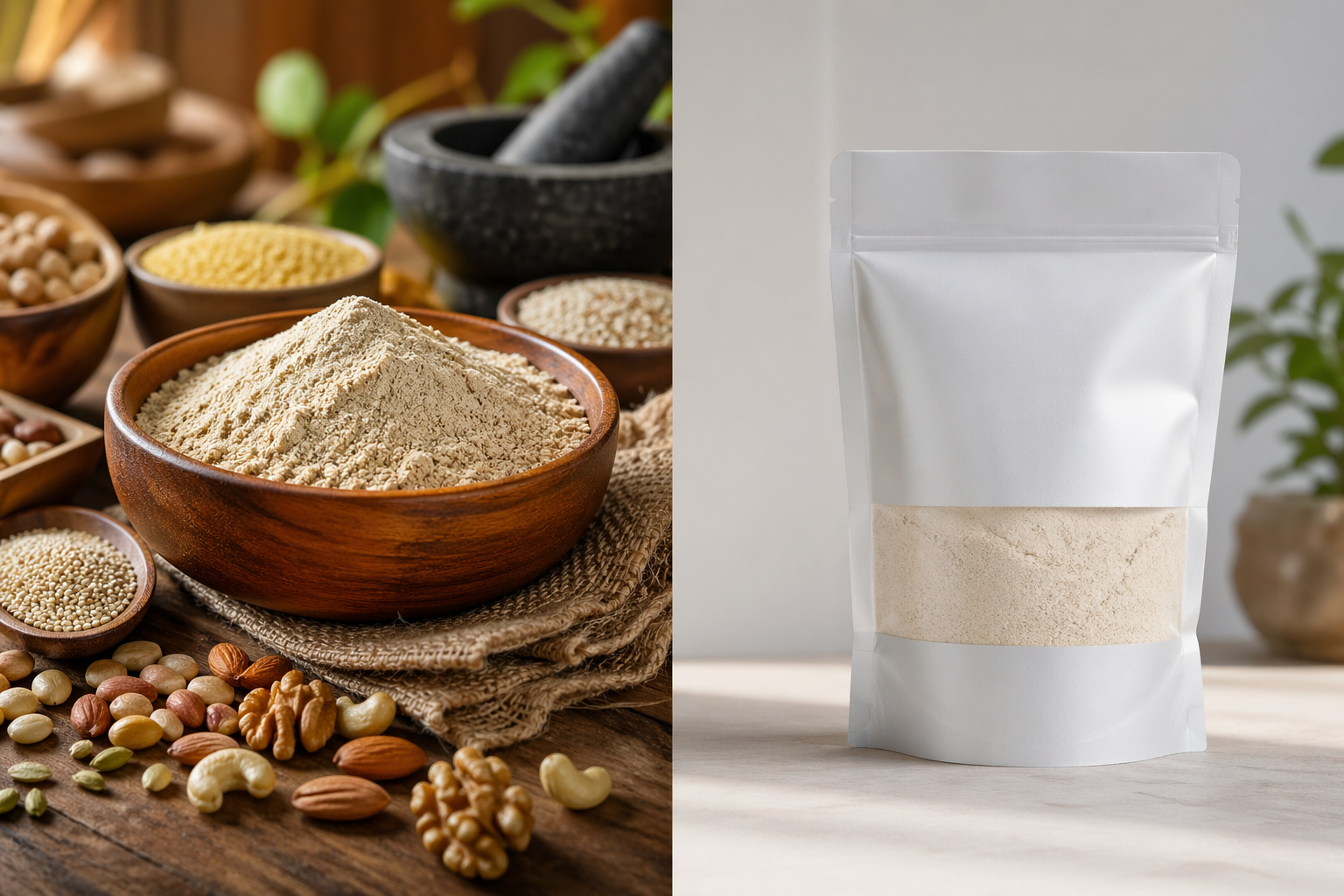
Homemade vs Store Health Mix – Which One is Right for Your Family? (2026 Guide)
In every Tamil Nadu household, the memory of sathu maavu is tied to a kitchen — the warm smell of roasting ragi, the sound of the mixie grinding pulses and nuts into a fine powder, and the sight of a grandmother measuring each ingredient with a practiced hand.
That tradition is beautiful. But in 2026, most families simply do not have the time, the ingredients, or the space to make it the way it was once made. So the question most parents are actually asking is not "homemade or store-bought?" — it is: "If I buy from a store, how do I know I am getting something close to what would have been made at home?"
This guide gives you an honest, detailed comparison — covering ingredients, freshness, cost, convenience, transparency and nutrition — so you can make the decision that is right for your family.
1. What is Sathu Maavu — The Original Homemade Health Mix
Sathu maavu literally means "nutritious powder" in Tamil. The traditional preparation involves cleaning, individually dry-roasting, and then grinding a combination of millets, grains, pulses, nuts and seeds into a fine, aromatic powder.
The process is meticulous. Each ingredient is roasted separately at the right temperature to bring out its flavour without burning it. Ragi, foxtail millet, green gram, black gram, almonds, cashews, flax seeds, cardamom — each one gets its turn in the pan before they are all combined and ground together.
The result is a powder that smells like roasted grain and nuts, with a subtle natural sweetness from dry dates and cardamom. When mixed with warm milk and cooked briefly, it becomes the porridge that generations of South Indian children grew up on.
2. Comparison 1: Ingredients — What Goes In
This is where the gap between homemade and store-bought is widest — and where most families are surprised when they actually read what is in the packet they have been buying.
What goes into a homemade health mix
- Ragi, foxtail millet, kodo millet, pearl millet
- Samba wheat, barley, red rice, boiled rice
- Green gram, black gram, horse gram, black channa
- Almonds, cashews, walnuts, pistachios
- Flax seeds, pumpkin seeds, sesame, sunflower seeds
- Cardamom, dry ginger, dry dates
- Nothing else — no additives, no fillers
What often goes into store-bought health mix
- Maltodextrin (cheap starch filler — often listed first)
- Corn syrup solids or glucose syrup solids
- Refined wheat flour or modified starch
- Artificial flavours or "nature-identical" flavouring
- Added sugar or sugar derivatives
- Chemical preservatives (sodium benzoate etc.)
- Vitamins added artificially to compensate for processing
The key test is simple: look at the ingredient list on the back of the packet and check what is listed first. Ingredients are listed in order of quantity — the first ingredient is present in the largest amount. If maltodextrin or corn syrup solids appear before the millets and pulses, you are paying for a filler product, not a nutrition product.
3. Comparison 2: Freshness and Shelf Life
Freshness matters more in health mix than in most other food products because several of the ingredients — particularly nuts, seeds and whole grains — contain natural oils that can become rancid over time. A stale health mix not only tastes different; it loses a significant portion of its nutritional value.
Homemade — The Freshness Advantage
When you make sathu maavu at home, you control exactly when it is made. A fresh batch ground on Saturday morning will be at peak freshness for the next two to three weeks if stored properly in an airtight container. The aroma alone tells you it is fresh — roasted nuts and grains have a distinct, warm smell that fades as the product ages.
Commercial Products — Shelf Life vs Freshness
Most commercial health mix products are designed to have a shelf life of 12 to 18 months. Achieving that shelf life without refrigeration typically requires either preservatives, very low moisture content achieved through heavy processing, or the removal of the oils and fats that make nuts and seeds nutritionally valuable in the first place.
A product that still smells and tastes like fresh roasted almonds after 12 months on a supermarket shelf should raise questions about how it was made.
The Small-Batch Difference
The best store-bought health mixes — those made in the tradition of homemade preparation — are produced in small batches and have a reasonable shelf life of 2 to 3 months. They may require refrigeration after opening, which is a sign that they contain real, natural oils rather than processed substitutes.
4. Comparison 3: Cost and Effort
This is the comparison that most honestly reflects why families have moved away from making sathu maavu at home — and also why the assumption that homemade is always cheaper is not necessarily accurate in 2026.
| Factor | Homemade | Good Quality Store-Bought |
|---|---|---|
| Ingredient cost | High — premium nuts and seeds are expensive to buy in small quantities | Moderate — bulk purchasing brings unit costs down |
| Time required | 3–5 hours for a full batch — sourcing, cleaning, roasting, grinding | 5 minutes to prepare a serving |
| Equipment needed | Heavy-duty mixie or mill, large pans, storage containers | None beyond a pot and spoon |
| Consistency | Varies — depends on roasting skill and ingredient quality each batch | Consistent across every packet |
| Ingredient variety | Limited by what you can source locally and afford individually | Can include 30–35 ingredients through bulk sourcing |
| Waste | Risk of over-roasting, spillage, or batch going stale | Minimal — measured portions per serving |
The honest calculation: buying almonds, walnuts, cashews, pistachios, flax seeds, pumpkin seeds, black sesame, and 25+ other ingredients in small quantities for a home batch is more expensive per gram than a quality store-made product that sources these ingredients in bulk. The cost argument for homemade is stronger if you are already buying these ingredients regularly for other uses.
5. Comparison 4: Transparency and Trust
Trust is arguably the most important factor in this comparison — especially when the product is being given to children every day.
Homemade — Complete Transparency
When you make health mix at home, you know exactly what is in it because you put it in yourself. You can see the ragi before it is ground. You can smell the almonds being roasted. You know that nothing else was added because you were there for the entire process. This is complete transparency — and it is the standard that all store-bought products should aspire to match.
What Transparency Looks Like in a Store-Bought Product
A trustworthy commercial health mix should offer:
- A complete ingredient list with every ingredient named specifically — not vague terms like "natural flavours" or "permitted additives"
- A valid FSSAI licence number that can be verified on the FSSAI website
- Clear information about preparation method — small batch vs mass production
- Honest shelf life — 2 to 3 months for a naturally-made product, not 18 months
- Contact details and a physical address for the manufacturer
- No front-of-pack health claims that cannot be substantiated by the actual ingredient list
6. Comparison 5: Nutritional Completeness
A well-made homemade health mix is arguably one of the most nutritionally complete single-food preparations available — if made with the right ingredients in the right quantities. The combination of millets, pulses, nuts and seeds covers calcium, iron, protein, healthy fats, fibre, and a wide range of vitamins and minerals that most daily diets lack.
However, the nutritional value of a store-bought product depends entirely on what is actually in it. Here is a simplified breakdown:
| Nutrient | Homemade (Well Made) | Premium Store-Bought | Mass-Market Commercial |
|---|---|---|---|
| Calcium | High — from ragi, sesame, almonds | High — if ragi and nuts are real | Low — unless artificially fortified |
| Iron | High — from millets, pulses, sesame | High — if ingredients are real | Low or artificially added |
| Protein | Good — from pulses and nuts | Good — if pulse content is real | Low — fillers replace pulses |
| Omega-3 | Present — from flax seeds and walnuts | Present — if seeds are real | Absent or synthetic |
| Dietary Fibre | High — from whole grains and pulses | High — if whole grains are used | Low — processing removes fibre |
| Glycaemic Index | Low — natural millet-based GI | Low — if millets are primary ingredient | High — maltodextrin spikes blood sugar |
7. The Verdict: What to Actually Look For
The comparison between homemade and store-bought health mix is not really homemade vs store-bought. It is genuine vs processed. A well-made small-batch store product can match homemade quality in almost every meaningful way — while a mass-market commercial product can be nutritionally inferior to both.
The conclusion: if you have the time and resources to make sathu maavu at home using quality ingredients, do it. The homemade version remains the gold standard. But if you are looking for a store-bought alternative, the right choice is one that mirrors homemade preparation as closely as possible — not one that replaces it with a processed approximation.
The checklist for a genuinely good store-bought health mix:
- Millets and pulses listed first in the ingredient list — not maltodextrin
- No preservatives, no artificial additives, no added sugar
- Valid FSSAI licence number
- Shelf life of 2–3 months — not 18 months
- Made in small batches — not mass factory production
- Real nuts and seeds in meaningful proportions — not trace amounts
- Full ingredient transparency — every ingredient named specifically
8. Where Jeevansakthi Fits
Jeevansakthi was not designed to replace the tradition of homemade sathu maavu. It was designed to honour it — for families who want the same quality, the same ingredient integrity, and the same nutritional completeness of homemade preparation, without the three to five hours it takes to make a batch from scratch.
Every batch of Jeevansakthi is made with 35 natural ingredients — millets, grains, pulses, nuts, seeds and spices — slow-roasted the traditional way, in small quantities, with no maltodextrin, no preservatives, no added sugar, and no artificial additives of any kind. It is the product we wanted to find when we were looking for something trustworthy to give our own family.
We believe that a good store-bought health mix should pass one simple test: if the person who made it would serve it to their own children every morning — it is worth buying. That is the standard we hold ourselves to at Jeevansakthi.
Homemade Quality. Store Convenience.
35 natural ingredients. No maltodextrin. No preservatives. No added sugar. Made fresh in small batches — the same way it would be made at home.
Shop Jeevansakthi Health Mix →Related Reading