

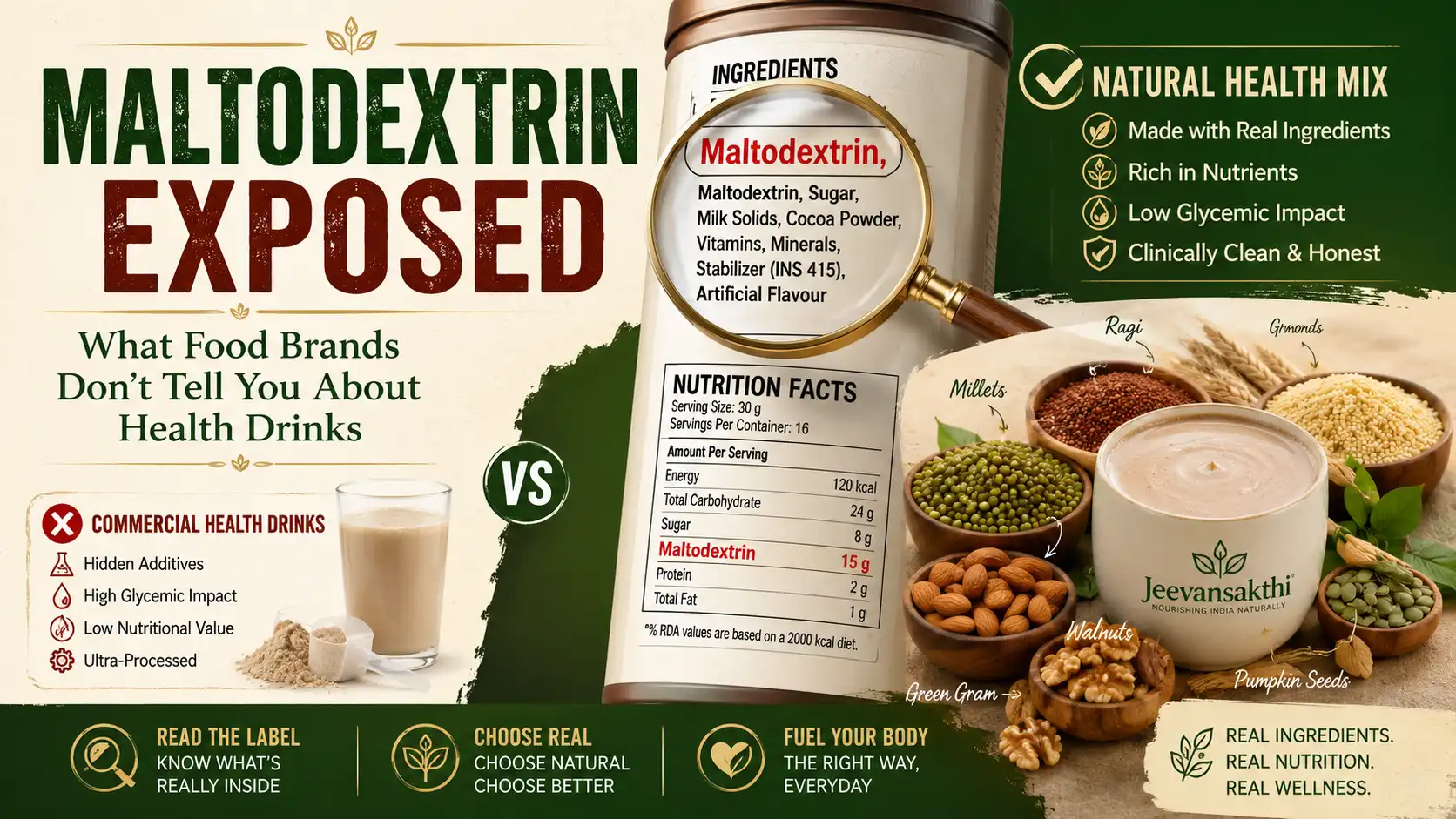
What is Maltodextrin? Why You Should Avoid It in Commercial Health Drinks
Next time you pick up a popular health drink powder from a supermarket shelf, flip the packet over and read the ingredients list. Chances are, somewhere near the top, you will find one word that does not belong in a wholesome, natural product — Maltodextrin.
Most people skim past it without a second thought. But if you are buying health mix for your children or family, this is one ingredient worth understanding. This article explains exactly what maltodextrin is, why food companies use it so widely, what it does to your body, and why traditional health mixes like Jeevansakthi choose to leave it out entirely.
1. What is Maltodextrin?
Maltodextrin is a white, powdery food additive made by partially breaking down starch — usually from corn, wheat, rice, or potato — using a process called hydrolysis. The result is a highly processed carbohydrate that dissolves easily in water, has very little flavour of its own, and blends smoothly into powdered food products.
It is technically classified as a carbohydrate, but it behaves very differently from the complex carbohydrates found in whole grains, millets, or pulses. While a grain of ragi or a handful of green gram provides fibre, minerals, and slow-releasing energy, maltodextrin provides almost nothing except quick-absorbing, empty calories.
Maltodextrin vs. Natural Carbohydrates — What’s the Difference?
| Property | Maltodextrin | Natural Grain (e.g. Ragi) |
|---|---|---|
| Source | Processed starch (corn, wheat) | Whole millet grain |
| Glycaemic Index | Very high (85–105) | Low to moderate (54–68) |
| Fibre | None | Present |
| Minerals | None | Calcium, Iron, Magnesium |
| Energy release | Rapid spike | Slow and sustained |
| Processing level | Highly processed | Minimally processed |
2. Why Do Food Companies Use Maltodextrin?
If maltodextrin offers so little nutritional value, why is it so widely used? The answer is straightforward — it is extremely convenient and inexpensive for manufacturers.
It Is Cheap
Almonds, walnuts, ragi, and other quality ingredients cost significantly more than starch-derived fillers. By replacing a portion of premium ingredients with maltodextrin, manufacturers can maintain or increase profit margins while keeping retail prices competitive.
It Improves Texture and Mixability
Maltodextrin dissolves easily and gives powdered drinks a smooth, consistent texture. It prevents clumping, makes the powder flow well, and helps other ingredients blend uniformly — making it ideal for mass production.
It Extends Shelf Life
Maltodextrin is stable, dry, and resistant to moisture absorption, which helps powdered products stay fresh on supermarket shelves for 12–18 months or more.
It Adds Bulk Without Weight
Manufacturers can fill a larger packet with less actual nutritive ingredient by using maltodextrin as a carrier or filler. A 500g packet may look full, but the actual content of millets, pulses, and nuts could be a fraction of what the label implies.
3. Health Concerns You Should Know About
Maltodextrin is generally recognised as safe by food authorities when consumed in small amounts. However, the concern is not about occasional exposure — it is about consuming it daily, especially in products marketed as health foods for children and families.
Very High Glycaemic Index
Maltodextrin has a glycaemic index (GI) of 85 to 105 — higher than table sugar, which has a GI of around 65. This means it is absorbed into the bloodstream extremely quickly, causing a rapid spike in blood sugar. For children who consume health drinks every morning, this is a significant concern, particularly over time.
No Fibre, No Micronutrients
Unlike whole grains and pulses, maltodextrin contains no dietary fibre, no vitamins, and no minerals. It contributes calories without contributing any of the nutrition that a genuine multi-grain health mix should provide.
May Displace Real Nutrition
When a child drinks a glass of health powder that is largely maltodextrin, they feel full — but they have not received the minerals, amino acids, or fibre that their body actually needs. The drink displaces a real nutritional opportunity with empty bulk.
Not Suitable for Everyone
People managing blood sugar levels, insulin sensitivity, or weight should be especially cautious. A product that raises blood sugar faster than sugar itself is not a health product — regardless of what the front of the packet says.
4. Maltodextrin in Commercial Health Drinks
Walk through any pharmacy or supermarket in Tamil Nadu and you will find shelves lined with well-known health drink brands — many of which are heavily advertised on television and trusted by families for decades. But look closely at the ingredients.
Several popular commercial health drink powders list maltodextrin, corn syrup solids, or other processed starches as primary ingredients — often above the millets or pulses that appear prominently on the front of the box.
This is not a small distinction. Ingredients are listed in order of quantity — the ingredient listed first is present in the largest amount. If maltodextrin is listed before ragi, wheat, or green gram, it means there is more maltodextrin in the product than any individual whole grain.
What to Look For When Reading Labels
| What You See on the Front | What to Check on the Back |
|---|---|
| “Made with Millets” | Is millet listed before or after maltodextrin? |
| “26 Natural Ingredients” | Are fillers or starches among those 26? |
| “No Added Sugar” | Is maltodextrin (which behaves like sugar) present? |
| “Trusted by Families” | What is the actual ingredient quality? |
| “High Protein” or “High Fibre” | What is the source — real pulses or isolates? |
5. How to Identify Maltodextrin on a Label
Maltodextrin does not always appear under its own name. Food manufacturers sometimes use alternative names or related compounds that serve the same purpose. Here are the terms to watch for:
- Maltodextrin — the most common name
- Corn syrup solids — derived from corn starch, similar properties
- Modified starch — a broad term that may include maltodextrin
- Dextrose — a simple sugar derived from starch hydrolysis
- Glucose syrup solids — another processed starch derivative
- Hydrolysed starch — the process used to make maltodextrin
6. What to Choose Instead
The good news is that a genuinely clean, natural health mix exists — and it has existed in Indian kitchens for generations. The traditional sathu maavu or multi-grain porridge that grandmothers prepared at home contained none of these additives. It was simply whole grains, pulses, nuts, and seeds — cleaned, slow-roasted, and ground fresh.
When choosing a health mix for your family, look for products that:
- List only recognisable, whole-food ingredients
- Do not include maltodextrin, corn syrup solids, or modified starch
- Are made in small batches to ensure freshness
- Are transparent about what is inside and in what proportion
- Are FSSAI registered with a valid licence number
- Contain a meaningful proportion of premium ingredients like nuts and seeds
What Jeevansakthi Contains — and Does Not Contain
| Jeevansakthi Contains | Jeevansakthi Does NOT Contain |
|---|---|
| Ragi, Foxtail Millet, Kodo Millet, Barnyard Millet | Maltodextrin |
| Almonds, Walnuts, Cashews, Pista | Corn syrup solids |
| Green Gram, Horse Gram, Black Gram | Artificial flavours or colours |
| Flax Seeds, Pumpkin Seeds, Sunflower Seeds | Added sugar or sweeteners |
| Dry Ginger, Cardamom, Dry Dates | Chemical preservatives |
| 26–35 natural ingredients per variant | Fillers or modified starch |
22% of Jeevansakthi’s blend is made up of premium nuts and seeds — almonds, walnuts, cashews, and pumpkin seeds. This is not a marketing claim. It is a reflection of what goes into every packet, prepared the same way we would prepare it for our own family.
The Bottom Line
Maltodextrin is not a poison. In small quantities and in appropriate contexts, it is harmless. But it has no place in a product that is sold as a health food for children and families — and it certainly should not be a primary ingredient in something marketed as a nutritious multi-grain health mix.
The next time you shop for a health drink powder, spend thirty seconds reading the ingredients list on the back of the packet. That thirty seconds of attention could make a meaningful difference to what your family is actually consuming every morning.
Traditional food wisdom has always been simple: eat whole, natural ingredients prepared with care. Everything else is just packaging.
Try a Health Mix Made Without Shortcuts
Jeevansakthi contains 26–35 natural ingredients — millets, grains, pulses, nuts and seeds. No maltodextrin. No preservatives. No added sugar. Made fresh in small batches, the traditional way.
Shop Jeevansakthi Health Mix →Related Reading