

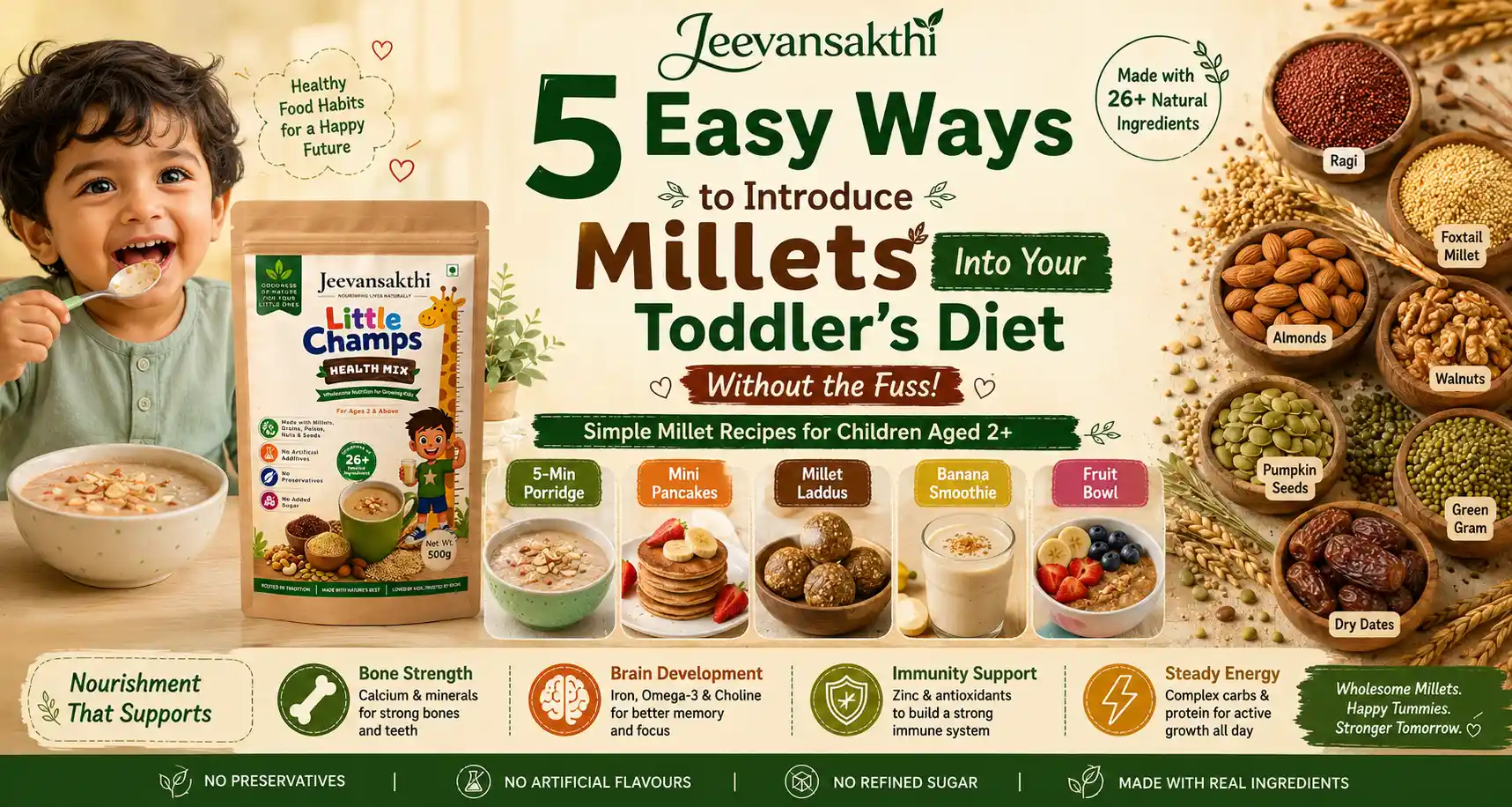
5 Easy Ways to Introduce Millets into Your Toddler’s Diet (Without the Fuss)
If you have ever tried to get a two-year-old to eat ragi, you already know the challenge. Millets are nutritionally exceptional — but most toddlers do not care about nutrition. They care about texture, taste, and whether the food looks interesting enough to eat.
The good news is that millets do not have to come as a plain, unflavoured porridge that a toddler pushes away after one spoonful. With a little creativity — and the right base ingredient — millets can be introduced in ways that children genuinely enjoy. Mini pancakes, soft laddus, creamy porridge, fruit bowls and warm drinks — millets can appear in all of them.
This guide gives you five practical, tested ways to introduce millets to your toddler or young child, starting from age 2, with preparation times of five minutes or less for most options.
Why Millets Are So Important for Toddlers
The ages of 2 to 6 are among the most nutritionally critical years of a child’s life. Bones are forming, brain connections are developing at speed, the immune system is maturing, and healthy weight gain is essential. The nutrients toddlers need most — calcium, iron, zinc, healthy fats and fibre — are exactly what millets and a well-made multi-grain health mix provide.
The challenge is not the nutrition — it is the delivery. Here are five ways that actually work.
Warm Millet Porridge
The classic 5-minute fix — smooth, creamy, and surprisingly loved by most toddlers
- 2 tbsp Jeevansakthi Little Champs Health Mix
- 1 cup whole milk (or water)
- 2–3 tbsp warm water (for paste)
- 1 tsp honey or jaggery (optional, ages 2+)
- A pinch of cardamom (optional)
- Mix health mix powder with 2–3 tbsp warm water to form a lump-free paste.
- Add the cup of milk gradually, stirring as you pour.
- Cook on medium flame for 3–4 minutes, stirring constantly, until it thickens to a smooth porridge.
- Cool slightly. Add honey or jaggery if desired.
- Serve warm in your toddler’s favourite bowl.
Mini Millet Pancakes
Finger food that toddlers eat themselves — and usually ask for more
- 3 tbsp Jeevansakthi Little Champs Health Mix
- 3 tbsp whole wheat flour or rice flour
- 1 small ripe banana, mashed
- 1 egg (or 2 tbsp yoghurt for egg-free)
- ½ cup milk
- A pinch of cardamom
- ½ tsp ghee or butter (for pan)
- Mash banana well until smooth. Mix with egg (or yoghurt) and milk.
- Add health mix powder and flour. Stir into a thick, smooth batter.
- Add a pinch of cardamom. Let it rest 2 minutes.
- Heat a non-stick pan on low-medium. Add a tiny bit of ghee.
- Pour small circles of batter (2–3 inch diameter) and cook until bubbles appear on top.
- Flip and cook 1 more minute. Serve warm.
No-Cook Millet Laddus
Traditional snack, zero cooking — ready in 10 minutes and lasts all week
- 4 tbsp Jeevansakthi Little Champs Health Mix
- 2 tbsp powdered jaggery
- 1 tbsp ghee (melted)
- 1–2 tbsp warm milk (to bind)
- Optional: 4–5 seedless dates, chopped fine
- Optional: a pinch of cardamom
- Mix health mix powder and jaggery in a bowl.
- Add melted ghee and mix well with your fingers until crumbly.
- Add warm milk one teaspoon at a time, mixing until the mixture holds its shape when pressed.
- Add chopped dates if using — they add natural sweetness and chewiness toddlers love.
- Roll into small, marble-sized balls.
- Store in an airtight container. Stays good for 4–5 days at room temperature.
Millet Banana Smoothie
Cold, creamy and naturally sweet — perfect for summer mornings or when porridge is refused
- 2 tbsp Jeevansakthi Little Champs Health Mix
- 1 ripe banana (frozen works even better)
- ¾ cup cold whole milk
- 2–3 tbsp yoghurt
- 1 tsp honey (optional, ages 2+)
- 2–3 ice cubes (optional)
- Add health mix powder and a small splash of milk to a glass or blender.
- Stir the powder into the milk first to avoid clumping.
- Add banana (broken into pieces), yoghurt, remaining milk and ice cubes.
- Blend for 30–45 seconds until completely smooth.
- Pour into a cup with a straw — toddlers drink more when there is a straw involved.
Millet Fruit Bowl
Mix it into something they already love — the sneaky parent method that always works
- 1 tbsp Jeevansakthi Little Champs Health Mix
- ½ cup thick yoghurt or hung curd
- 1 tbsp honey
- Fruits your toddler likes — banana, mango, strawberry, chikoo
- Optional: a tiny pinch of cardamom
- Mix health mix powder into the yoghurt with honey. Stir well until smooth.
- The yoghurt will become slightly thicker and have a pleasant nutty flavour.
- Chop fruits into toddler-friendly pieces — small enough to eat safely.
- Arrange fruit over the yoghurt base.
- Serve immediately or refrigerate for up to 2 hours.
General Tips for Introducing Millets to Toddlers
Start Small and Be Patient
Food acceptance in toddlers typically requires 10 to 15 exposures before a new food is accepted. If your child rejects millet porridge on day one, do not give up. Offer it again in a different form, at a different time, or mixed with a familiar favourite. Persistence — without pressure — is the key.
Let Them See You Eating It
Toddlers are powerful imitators. Eating the same millet porridge at the table alongside your child is one of the most effective ways to encourage acceptance. Children are far more likely to try food they see adults eating with apparent enjoyment.
Involve Them in the Preparation
Even two-year-olds can stir a bowl or pour powder into a cup. When children are involved in preparing food — however minimally — they are significantly more likely to eat it. Let them pour the health mix powder, stir the batter, or roll the laddus.
Vary the Presentation
The same millet porridge served in a bear-shaped bowl is more likely to be eaten than in a plain plate. Toddler food is as much about presentation as it is about taste. Mini portions, colourful fruit toppings, fun utensils — all of these reduce refusal.
Do Not Force or Bribe
Pressure around food creates negative associations that last for years. If your toddler refuses on a given day, simply remove the food without reaction and try again the next day. A relaxed mealtime environment is more conducive to food acceptance than any amount of encouragement or negotiation.
Why Little Champs Health Mix Makes Millet Introduction Easy
All five recipes in this guide use Jeevansakthi Little Champs Health Mix as the base. This is not incidental — the Kids formula is specifically designed with toddler acceptability in mind.
The blend uses mild spices — cardamom and dry dates rather than the stronger dry ginger used in the adult formula. The combination of ragi, nuts, seeds and pulses creates a naturally nutty flavour that most children find more pleasant than plain ragi flour. And because it is already roasted and ground, you skip the most time-consuming step that makes homemade sathu maavu impractical on busy mornings.
Five minutes in the morning. One ingredient. Five different ways to serve it. That is the practical reality of introducing millets to a toddler without making it a daily battle.
Start Your Toddler’s Millet Journey Today
Jeevansakthi Little Champs Health Mix — 26+ natural ingredients, no added sugar, no preservatives. Made fresh in small batches for growing children above 2 years.
Shop Little Champs Health Mix →Related Reading